

The Grass is Greener Delusion: Why Facilities (and Providers) Chase the Shiny Thing
What happens when facilities chase the next anesthesia group like a midlife crisis in scrubs.

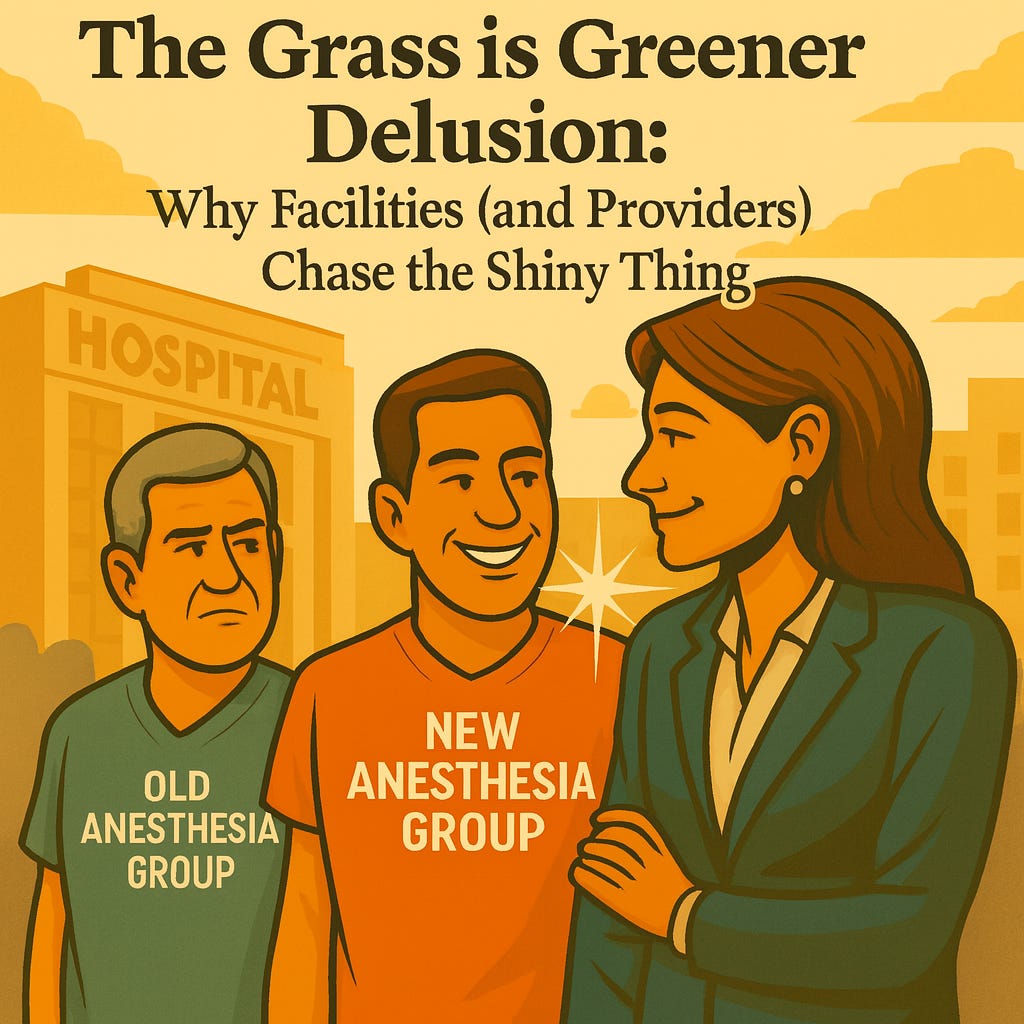
There’s a phrase in business and relationships known as “The Grass is Greener Delusion”
It’s when someone leaves a long-term partnership, convinced the grass is greener, the passion stronger, and the problems will magically disappear. But reality always sets in. The same challenges resurface, and the shiny “upgrade” quickly dulls, especially if the core issues were never addressed in the first place.
If you’ve worked in anesthesia long enough, you’ve seen this play out, not in marriages, but in contracts.
When Facilities Get The Grass is Greener Delusion
Hospitals and surgery centers sometimes do this too. They’ll have a stable, reliable anesthesia group that’s been there for years, maybe decades. The OR runs smoothly. Rooms are open. The outcomes are exceptional. The surgeons are happy.
Then the market shifts, salaries climb, malpractice costs spike, sign-on bonuses explode, and competition for anesthesia providers intensifies. The group does the professional thing: they come back to the table to talk about market changes, added coverage, or fair adjustments.
Not out of greed, but out of necessity, reflecting the true cost of keeping rooms open and coverage stable.
Instead of recognizing that reality, facility leadership starts “benchmarking” and “exploring options,” even when the Fair Market Value (FMV) comes back confirmatory. They seem convinced there must be a cheaper way to do the same job but all the while eroding confidence as the process is further delayed. On paper, shopping around isn’t unreasonable, but it becomes a crisis only because the facility has been insulated from market forces for so long. After years of undervaluing a loyal partner, a fair request for market pay suddenly feels like betrayal.
Translation: The Grass is Greener Delusion.
They start flirting with a national staffing company that promises the world, lower rates, more coverage, “turnkey” service, an app for everything. It’s exciting, shiny, and new.
And somehow, they convince themselves it will also be better for the anesthesia providers, that a corporate model with rotating faces and national oversight will reduce turnover and boost morale in a volatile market.
It doesn’t. It does the opposite.
The old group? “Too expensive.” “Too set in their ways.” “Too entitled.”
So the hospital divorces their long-term partner.
Fast-forward six months:
The long-term providers, the ones who carried the place through the lean years, finally move on, not for money, but because the endless negotiations and lack of communication left no room for trust.
The “new” group can’t staff the rooms.
The locums bill pile up.
Surgeons are frustrated.
The anesthesia call team is rotating weekly faces.
And suddenly, the CFO realizes those “savings” vanished in overtime, cancellations, and locum markups.
They didn’t fix their problems, they just traded familiar ones for new ones.
The first partner wasn’t the problem. The problem was the relationship.
And in anesthesia, relationships are what make systems work, communication, trust, reliability, institutional memory.
When Providers Catch It Too
It’s not just facilities.
Anesthesia providers, CRNAs, AAs, and Physician Anesthesiologists alike, sometimes fall into the same trap.
You’ve been at a facility for years. You know the staff, the surgeons, the routines and you feel respected. The pay is good. But then a recruiter calls.
The promise: “More money,” “better schedule,” “less call.”
It’s tempting, who doesn’t like the idea of something new?
But after you make the jump, you realize the new environment isn’t what was promised. The leadership’s disorganized. The politics are worse. The culture is toxic. The pay isn’t quite what you thought after taxes, travel, or shift changes.
Maybe it’s a short-term locums contract that gets canceled halfway through, or the “perfect” gig that evaporates before it even starts. Suddenly you’re between jobs, chasing the next promise, wondering why the greener grass keeps dying under your feet.
That “better deal” starts to look a lot like a midlife crisis in scrubs.
The Cost of the Trade
The Grass is Greener Delusion, whether in marriage or medicine, comes down to one thing: emotion over analysis.
We mistake novelty for improvement.
We conflate change with progress.
We think swapping partners (or providers) fixes the underlying dysfunction, when in fact, it just restarts the cycle.
The most successful facilities I’ve worked with are the ones that invest in the relationship.
They over-communicate.
They handle disagreements directly and professionally.
They review contracts honestly and adjust as circumstances change.
They treat anesthesia not as a commodity but as a clinical partnership.
And the best providers?
They understand their ROI, but they also understand context.
Sometimes the grass looks greener because someone’s painting it that way.
Reality Check
Before you leave your long-term anesthesia partner, whether you’re a facility or a provider, ask yourself:
Are you chasing something better?
Or just something different?
Because even though change isn’t always bad, the next deal isn’t always the better one, sometimes it’s just the most expensive way to relearn what already worked.
Those corporations that promise the un-deliverable should be outed. Stability in an anesthesia department is essential to a smooth operating room that keeps the money coming in. Without anesthesia, there is disruption, leading to questionable practices.
Great write up! I’ve watched this cycle too, where providers chasing the next “big thing,” sold on grand promises that turn out to be smoke and mirrors. In the end, many find themselves returning to the very bridges they once burned. The grass always looks greener until you realize it’s just different turf. Thx, Mike!