

Titles Matter. So Does the Double Standard.
If “provider” is too vague for physicians, then selective outrage over “nurse anesthesiologist” is not about transparency. It is about hierarchy.


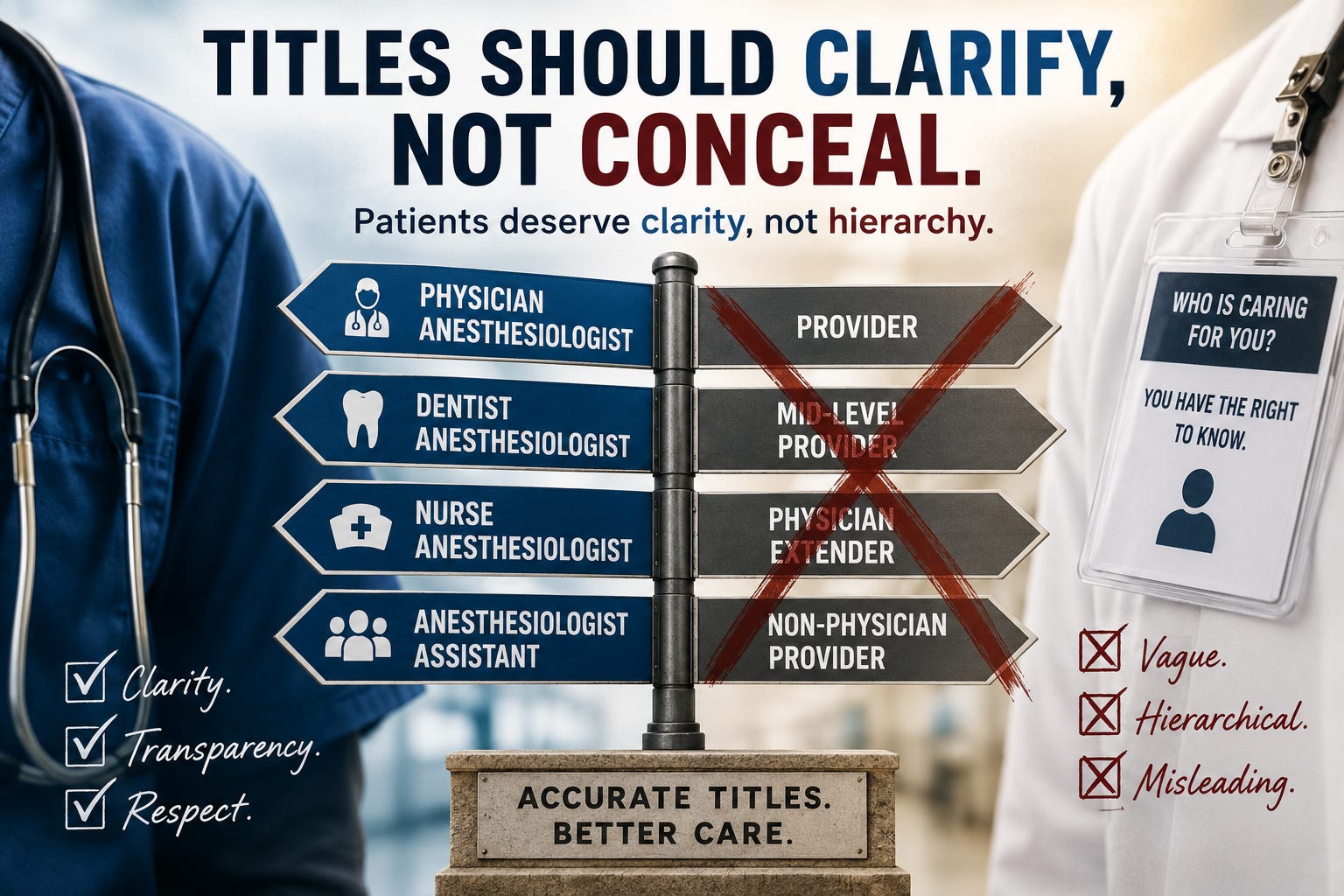
The American College of Physicians recently published a policy paper arguing that physicians should not be referred to as “providers.” On that point, I agree with them.
“Provider” is a vague corporate term. It does not tell a patient who is actually standing in front of them, what license that person holds, what education they completed, or what role they are playing in the patient’s care. It is the kind of language that makes clinicians easier to treat as interchangeable labor units, which is not good for patients or professionals.
But if we are going to say names matter, then names have to matter for everyone. This is where the discussion becomes more complicated. The objection to “provider” is framed as a transparency issue, but the objection to titles like “nurse anesthesiologist” and “Physician Associate” often seems to operate by a different standard. Physician anesthesiologist is accepted. Dentist anesthesiologist is accepted. Certified Anesthesiologist Assistant is accepted. Yet nurse anesthesiologist is treated as uniquely confusing, even though the word “nurse” is right there in the title.
That inconsistency is the point. If the concern is truly patient understanding, then the solution should be precise titles for everyone, not selective title protection for some.
If we are going to say names matter, then names have to matter for everyone.
The Problem with “Provider”
I have never liked the term “provider.” It is impersonal, imprecise, and transactional. It sounds less like a professional identity and more like a line item in a staffing spreadsheet. In that sense, physicians are right to object to it.
The term also blurs meaningful differences in education, licensure, certification, scope, accountability, and role. A patient should not have to decode who is caring for them by guessing from a generic label. They should be told directly. But that principle cannot stop at physicians. If “provider” is not good enough because it hides professional identity, then the answer is not to reserve precise language for one profession while expecting everyone else to accept broader, vaguer, or more subordinate labels. The answer is to be specific about everyone.
A physician should be called a physician. A CRNA should be called a CRNA. A dentist should be called a dentist. A physician anesthesiologist should be called a physician anesthesiologist. A dentist anesthesiologist should be called a dentist anesthesiologist. A nurse anesthesiologist should be called a nurse anesthesiologist.
That is not confusion; it is clarification. The title identifies the clinical domain, and the modifier tells the patient the professional pathway. Together, they give the patient more information, not less.
Doctor Is Not the Same as Physician
A major problem in these debates is that “doctor” and “physician” are often treated as though they are interchangeable. They are not.
“Doctor” is an academic and professional title earned through completion of a doctoral degree. “Physician” is a licensure-based professional identity tied to MD or DO education and medical practice. Those two realities can coexist without threatening either one.
A person with an MD or DO is a physician. A person with a doctorate has earned the title doctor, subject of course to applicable state law, facility policy, and appropriate disclosure of credentials and discipline.
The ethical solution is not to erase doctoral education from every non-physician profession. The ethical solution is to disclose clearly. “Dr. Jane Smith, DNP, CRNA, nurse anesthesiologist” tells the patient much more than “your anesthesia provider will see you now.” It identifies the doctorate, the credential, the discipline, and the role. The same is true for “Dr. John Smith, MD, physician anesthesiologist” or “Dr. Alex Lee, DDS, dentist anesthesiologist.” Each title is specific. Each title discloses the professional pathway. Each title helps the patient understand who is involved in their care.
That is transparency.
The Anesthesia Title Debate Exposes the Inconsistency
Anesthesia is a useful place to test whether the concern is truly patient confusion, because multiple professions practice in the same clinical space.
Physician anesthesiologist is a descriptive title. It tells the patient that the anesthesia professional is a physician practicing anesthesiology. Dentist anesthesiologist is also a descriptive title. It tells the patient that the anesthesia professional is a dentist practicing anesthesiology. Nurse anesthesiologist is no different in structure. It tells the patient that the anesthesia professional is a nurse practicing anesthesiology as a CRNA.
This is why the objection to “nurse anesthesiologist” is hard to reconcile with the widespread use of “physician anesthesiologist.” Once the modifier is accepted in one context, the argument has already conceded that “anesthesiologist” can function as a practice-domain descriptor clarified by the professional pathway in front of it.
That is exactly what “nurse anesthesiologist” does.
The Timeline Matters
There is also a common misconception in this debate that deserves to be corrected. The story often gets told as though CRNAs created “nurse anesthesiologist” first in order to sound like physician anesthesiologists, and that “physician anesthesiologist” emerged later as a defensive response.
That is not the chronology.
The term “physician anesthesiologist” was already being used in organized anesthesiology messaging years before the AANA formally recognized “nurse anesthesiologist” as a descriptor. ASA’s public-facing “When Seconds Count” materials used “physician anesthesiologist” in the 2013-era public messaging around physician-led anesthesia care. AANA’s formal recognition of “nurse anesthesiologist” came later, with the Board’s 2019 recognition of the descriptor, the 2020 member resolution, and the 2021 organizational rebrand.
That changes the frame. The title “nurse anesthesiologist” did not invent the modifier structure. Organized medicine had already normalized that structure through the use of “physician anesthesiologist.”
“Nurse anesthesiologist” did not create the modifier structure. The ASA had already embraced that structure with “physician anesthesiologist” years before.
Once “physician anesthesiologist” became acceptable, the logic was already established: the professional pathway comes first, and the anesthesia domain follows. Physician anesthesiologist. Dentist anesthesiologist. Nurse anesthesiologist.
The modifier is not a trick. It is the clarification.
That is also why the claim that “nurse anesthesiologist” is inherently misleading has always struck me as overstated. It says nurse. It identifies the profession. It ties the professional identity to the actual clinical domain of anesthesia and anesthesiology. It can be paired with CRNA, doctorate, license, and role disclosure. That is more transparent than telling a patient that their “anesthesia provider” will be in shortly.
There is also public-perception evidence that complicates the claim that patients are automatically confused by the term. A national survey of over 4000 registered voters commissioned during the title debate found that respondents were more likely to select “nurse anesthesiologist” than “nurse anesthetist” as the term that best described a professional nurse who provides anesthesia during surgery. The same polling found that respondents recognized the difference between a nurse anesthesiologist as a member of the nursing profession and a physician anesthesiologist as a medical doctor by a three-to-one margin.
That does not mean every patient understands every title perfectly. They do not. It does mean the blanket claim that “nurse anesthesiologist” is uniquely confusing deserves more scrutiny than it usually receives.
The Anesthesiologist Assistant Double Standard
The inconsistency becomes even more difficult to defend when we look at anesthesiologist assistants.
Some of the same voices that object to “nurse anesthesiologist” appear to have no problem with “Certified Anesthesiologist Assistant.” That matters because the word “anesthesiologist” is also right there in that title.
If the concern is that patients may see the word “anesthesiologist” and misunderstand the role, then that concern should apply consistently. It should apply to physician anesthesiologist, dentist anesthesiologist, nurse anesthesiologist, and anesthesiologist assistant. But in practice, the concern is not applied consistently.
“Physician” is treated as clarifying. “Dentist” is treated as clarifying. “Assistant” is treated as clarifying. Somehow, “nurse” is treated as uniquely confusing.
There is an additional irony here. Organized anesthesiology has also used “anesthetist” broadly enough to include anesthesiologist assistants, even though “anesthetist” has historically been closely associated with CRNAs. So the concern does not appear to be consistent overlap. The concern appears to depend on who benefits from the overlap.
The concern does not appear to be consistent overlap. The concern appears to depend on who benefits from the overlap.
When an anesthesiologist assistant uses a title containing “anesthesiologist,” the modifier “assistant” is accepted as clarifying. When a CRNA uses a title containing “anesthesiologist,” the modifier “nurse” is treated as confusing.
That is the double standard.
The Physician Associate Debate Shows the Same Pattern
This same pattern is visible outside anesthesia as well.
The PA profession has had its own title debate, with the American Academy of Physician Associates adopting “Physician Associate” as the official title of the profession. Supporters of the change argue that “associate” better reflects the modern PA role and avoids the outdated impression that PAs are merely technical assistants rather than licensed medical professionals with defined education, certification, and scope.
Organized medicine’s response has been predictable. The objection is again framed around patient confusion. The concern is that patients may see the word “physician” in “Physician Associate” and assume the person is a physician.
That concern is not unreasonable at its face value. Patients should absolutely know whether the person caring for them is a physician, PA, CRNA, nurse practitioner, dentist, resident physician, fellow, assistant, NAR, or any other member of the care team. Clear disclosure matters.
But the selective pattern is still hard to ignore. When “assistant” appears in a title, it is treated as clarifying. When “physician” appears in “physician anesthesiologist,” it is treated as clarifying. When “dentist” appears in “dentist anesthesiologist,” it is treated as clarifying. But when a profession seeks a title that better reflects its current role, whether “Physician Associate” for PAs or “nurse anesthesiologist” for CRNAs, the language is suddenly treated as dangerous, confusing, or misleading.
The controversy is not simply about whether patients understand words. It is about which words are allowed to elevate a profession’s perceived standing and which words are expected to keep that profession in a subordinate position.
If the standard is transparency, then apply it evenly. Require clear credentials. Require role disclosure. Require identification of licensure and scope. But do not pretend that “assistant” is inherently transparent while “associate” is inherently misleading, or that “physician anesthesiologist” is clear while “nurse anesthesiologist” is confusing.
That is not a consistent patient-protection standard. It is a status-protection standard.
This Is About Perceptual Rank
I understand why this debate is usually framed as patient protection. No serious health care professional wants patients confused or misled. Patients deserve accurate information about who is caring for them.
But if the true goal is patient understanding, then the solution should be more specificity, not less. The answer should be clearer disclosure of credentials, licensure, discipline, and role. It should not be selective suppression of titles used by one profession while similar constructions are accepted for another.
My concern is that this debate is often less about what patients understand and more about perceptual rank. Titles shape status. Status shapes assumptions. Assumptions shape power.
Titles shape status. Status shapes assumptions. Assumptions shape power.
If one profession is allowed precise and prestigious language while another is pushed toward generic or historically subordinate language, the result is not transparency. It is hierarchy dressed up as transparency. That distinction matters. Health care teams do not function best when language is used to preserve rank. They function best when language accurately describes role, expertise, accountability, and contribution.
This is where the “proper recognition” framing can become misleading. Proper recognition should not mean preserving one profession’s prestige while minimizing another profession’s expertise. Proper recognition should mean accurate recognition. It should mean patients understand who is in the room, what that person is trained and licensed to do, and what role that person is performing in the patient’s care.
The “Mid-Level” Label Makes the Hierarchy Obvious
The same issue shows up in another term that many APRNs and PAs have rejected for years: “mid-level.”
On the surface, “mid-level provider” may sound like harmless administrative shorthand. It is not. It creates a rank before the conversation even begins. If someone is “mid-level,” then by implication someone else is “high-level,” and someone else must be below that. The hierarchy is built into the phrase.
That is why organizations such as the ANA, AANP and AANA have pushed back against terms like “mid-level provider,” “physician extender,” and “non-physician provider.” These terms do not simply describe a role. They define professionals in relation to physicians, rather than by their own education, licensure, certification, scope, and accountability.
This is relevant because some of the same institutions that object to certain professional titles in the name of patient clarity still use, tolerate, or benefit from language that is much less clear and far more hierarchical. “Mid-level” does not tell the patient whether someone is a CRNA, PA, NP, clinical nurse specialist, certified nurse-midwife, anesthesiologist assistant, or another licensed professional. It does not clarify training. It does not clarify scope. It simply ranks.
That is why the term belongs in this discussion. If the goal is transparency, then “mid-level” fails the test. It is not patient-centered language. It is status-centered language.
The better approach is to identify people by what they are: physician, CRNA, PA, nurse practitioner, dentist, pharmacist, anesthesiologist assistant, resident physician, NAR, or another specific professional role. That gives patients real information. Ranking people into high, middle, and implied lower levels does not.
“Mid-level” does not clarify training. It does not clarify scope. It simply ranks.
No One Should Imply Credentials They Do Not Hold
None of this means that titles should be used carelessly. They should not.
A CRNA should not imply they are a physician. A physician should not imply they personally performed care they did not provide. A dentist should not imply they are an MD or DO physician. An anesthesiologist assistant should not imply independent licensure or independent anesthesia practice. A resident, fellow, assistant, NAR, or trainee should be clearly identified.
That part should be straightforward. The standard should be simple: say who you are, what your credentials are, what license or certification you hold, and what role you are performing in the patient’s care.
It is also fair to acknowledge that title laws, facility policies, and regulatory language vary by state and setting. Professionals should comply with applicable law and policy. But that is a separate question from whether the descriptor itself is inherently misleading. A term can be subject to local rules and still be descriptively accurate.
“Nurse anesthesiologist” does not hide the nursing identity. It states it directly. It does not erase the CRNA credential. It can be paired with it. It does not claim physician status. It distinguishes the professional pathway from physician anesthesiologist and dentist anesthesiologist while identifying the common clinical domain.
That is the transparency patients deserve. Not vague corporate language. Not selective title protection. Not professional branding masquerading as patient advocacy. Just clear, accurate, consistent disclosure.
The Better Standard
The better standard is not complicated.
Use “physician” for MDs and DOs. Use “CRNA” for CRNAs. Use “dentist” for DDS and DMD professionals. Use “doctor” when a doctorate has been earned, with appropriate disclosure of discipline and credentials. Use descriptive anesthesia titles that clarify the professional pathway, including physician anesthesiologist, nurse anesthesiologist, dentist anesthesiologist, and anesthesiologist assistant.
And avoid “provider” when a more precise title is available.
That approach protects patients without erasing anyone. It respects physicians without subordinating everyone else. It recognizes that language matters, but refuses to let language become a proxy war for hierarchy.
On the central point, I agree with the ACP: names in health care have ethical significance. But that ethical significance belongs to all of us.
 | A guest post by
|
 | A guest post by
|
 | A guest post by
|
 | A guest post by
|
 | A guest post by
|
BRAVO! The fundamental problem is that our national Association, State Associations, Boards of Nursing and the membership at-large does not openly accept the logic. Until that happens, we will unfortunately never move forward.
what about referring to oneself as Dr. so and so because i have a doctorate in nursing practice?